
Battle of Britain Bunker The Polish Exhibition
“Had it not been for the magnificent material contributed by the Polish Squadrons and their unsurpassed gallantry, I hesitate to say that the outcome of battle would have been the same”.
The exhibition was installed to commemorate the 80th anniversary of the Battle of Britain (1940-2020) and was opened a year later in 2021.
We collaborated with the Polish Air Force Memorial Committee (PAFMC) to co-curate this special exhibition, which was the first, permanent exhibition in the UK about the role of the Polish Air Force during the war.
Many of the items here were kindly loaned to us by the PAFMC, and we are very grateful for our special bond which allows us to tell this story.
The Exhibition
The exhibition highlights the perilous journeys undertaken by Polish Air Force personnel following the invasion of Poland by Germany and the Soviet Union in 1939.
The variety of objects and documents tell stories of combat missions during the war and as well as telling the story of the airmen, highlight the different roles in the Polish Air Force beyond the pilots, including observers, ground crew and the Polish Women’s Auxiliary Air Force. The exhibition tells of the perilous journeys undertaken by Polish Air Force personnel following the invasion of Poland by Germany and the Soviet Union in 1939. It explores the military preparations in pre-war Poland and how the Polish Government in exile and military were organised in France and Britain during 1940.

The exhibition explores the military preparations in pre-war Poland and how the Polish Government in Exile and military were organised in France and Britain during 1940. A variety of objects and documents provide information on combat missions during the Second World War and highlight the different roles in the Polish Air Force including pilots, observers, ground crew and the Polish Women’s Auxiliary Air Force.
Many of the items in the exhibition are being shown to the public for the first time, alongside fascinating personal stories and historic film.
The Polish Air Force has a significant historical connection to Hillingdon. During the War, Polish fighter squadrons participated in air campaigns organised by Headquarters No. 11 Group (RAF Fighter Command) based at RAF Uxbridge. Squadrons were coordinated from the Battle of Britain Bunker, which was the Operations Room for No. 11 Group responsible for organising fighter aircraft based at airfields in the south-east of Britain.
Polish squadrons were stationed at RAF Northolt throughout the War and a Polish Liaison Officer was appointed at the Bunker to liaise directly with Polish Air Force High Command. In addition, South Ruislip (near RAF Northolt) is the location of the Polish Air Force Memorial erected to commemorate all who served with the Polish Air Force during the Second World War.

The exhibition was formally opened by His Excellency Professor Arkady Rzegocki, Ambassador of the Republic of Poland to the Court of St James’s and Councillor Sir Ray Puddifoot MBE, Hillingdon Armed Forces Champion. Ambassador Rzegocki said:
PROFILES
A total of 18 thousand men and women served in the Polish Air Force in Britain during the Second World War. It was a complete, compact and efficient air force organisation with 15 operational squadrons, which represented all principal service roles. Polish Air Force personnel were supported by a comprehensive training system including basic ground training, Polish elementary and service flying training schools, operational training, and a staff college. Below are six short profiles of Polish Air Force personnel and associated collections included in the exhibition.
General Władysław Sikorski
Group Captain Aleksander Gabszewicz
Prime Minister of the Polish Government in Exile and Commander-in-Chief of the Polish Armed Forces
Following the occupation of Poland in September 1939, a Polish Government in Exile was formed in France, while substantial numbers of Polish military personnel were evacuated to France and Britain. Whilst in France during 1940, Sikorski made the air arm of the Polish Army an independent service of the Polish Armed Forces. This became the Polskie Siły Powietrzne (PSP), known in Britain as the Polish Air Force. He continued to lead the Polish Armed Forces until his death in July 1943.
Collections: Officer’s uniform jacket, photographs

Pilot
In 1940 Gabszewicz served with No. 303 (Kościuszko) Squadron and in 1941 he joined the newly formed No. 316 (Warszawa) Squadron and was ‘A’ Flight Commander before taking command of the whole Squadron. In 1942 he was appointed the Polish Liaison Officer at the Bunker (HQ No. 11 Group). Later in the war, Gabszewicz was Wing Leader of the 1st Polish Wing at RAF Northolt and in 1943 he obtained an exchange posting to the 61st Fighter Squadron, 56th Fighter Group, United States Army Air Force (USAAF), flying combat sorties in P-47 Thunderbolts. In 1944 Gabszewicz took command of No. 18 (Polish) Sector between February and July, when he was in command of three wings, which included five Polish and four RAF/Allied squadrons. This was a fighter force bigger than the entire Polish fighter aviation in 1939.
Collections: Field service cap, flying jacket, scarf


Wing Commander Wieńczysław Barański
Leading Aircraftman Tadeusz Kwissa
Pilot
In October 1940 Barański participated in the Battle of Britain, serving with No. 607 Squadron (RAF) based at RAF Tangmere. In November he transferred to No. 303 (Kościuszko) Squadron and, between February and June 1941, he was ‘A’ Flight Commander with No. 316 (Warszawa) Squadron. Between 1941 and 1942 Barański was reposted as a Ground Control Officer with 316 Squadron and No. 308 (Kraków) Squadron. In October 1943 he took command of No. 302 (Poznań) Squadron and in 1944 he enrolled at the Polish Air Force Staff College and subsequently became a lecturer in fighter tactics.
Collections: Identification card, miniature medals, silk scarf, cigarette case

Ground Crew
Kwissa served with No. 303 (Kościuszko) Squadron from 1940 to 1943. On 4 July 1941 he was awarded the much valued ‘Kościuszko Badge’ – the 303 Squadron Commemorative Badge. On 21 September 1943 he was reposted with all No. 303 Squadron ground crew to 3105 Servicing Echelon at RAF Northolt. In 1944 Kwissa served with No. 308 (Kraków) Squadron (6308 Servicing Echelon) and, as part of No. 131 (Polish) Wing, serviced aircraft at advanced landing grounds in England and France.
Collections: wartime diaries, miniature medals, photographs

Collection Highlight
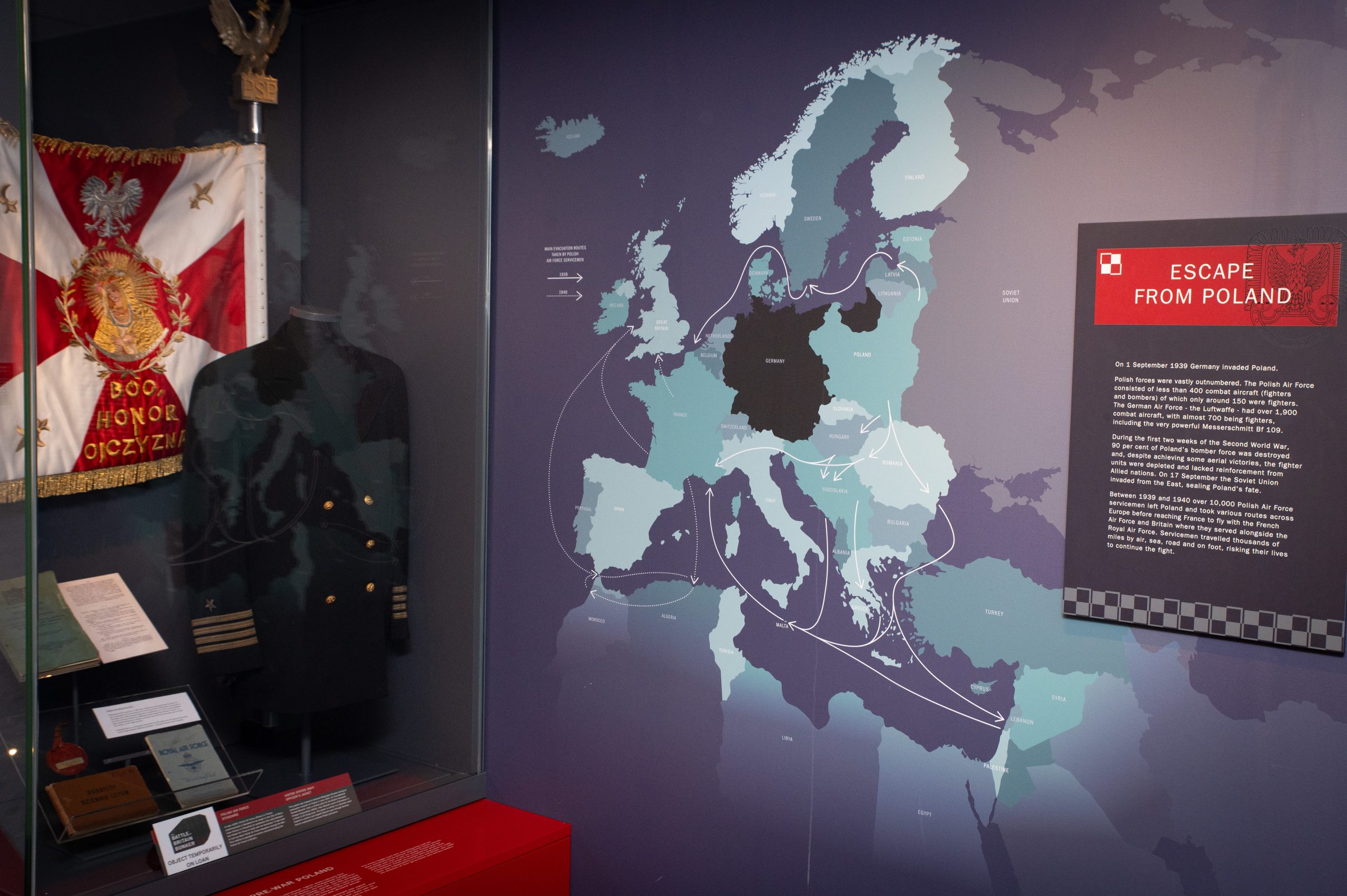
Escape Map
Escape Map: This escape map shows the various escape routes undertaken by Polish pilots following the Germany occupation of Poland.
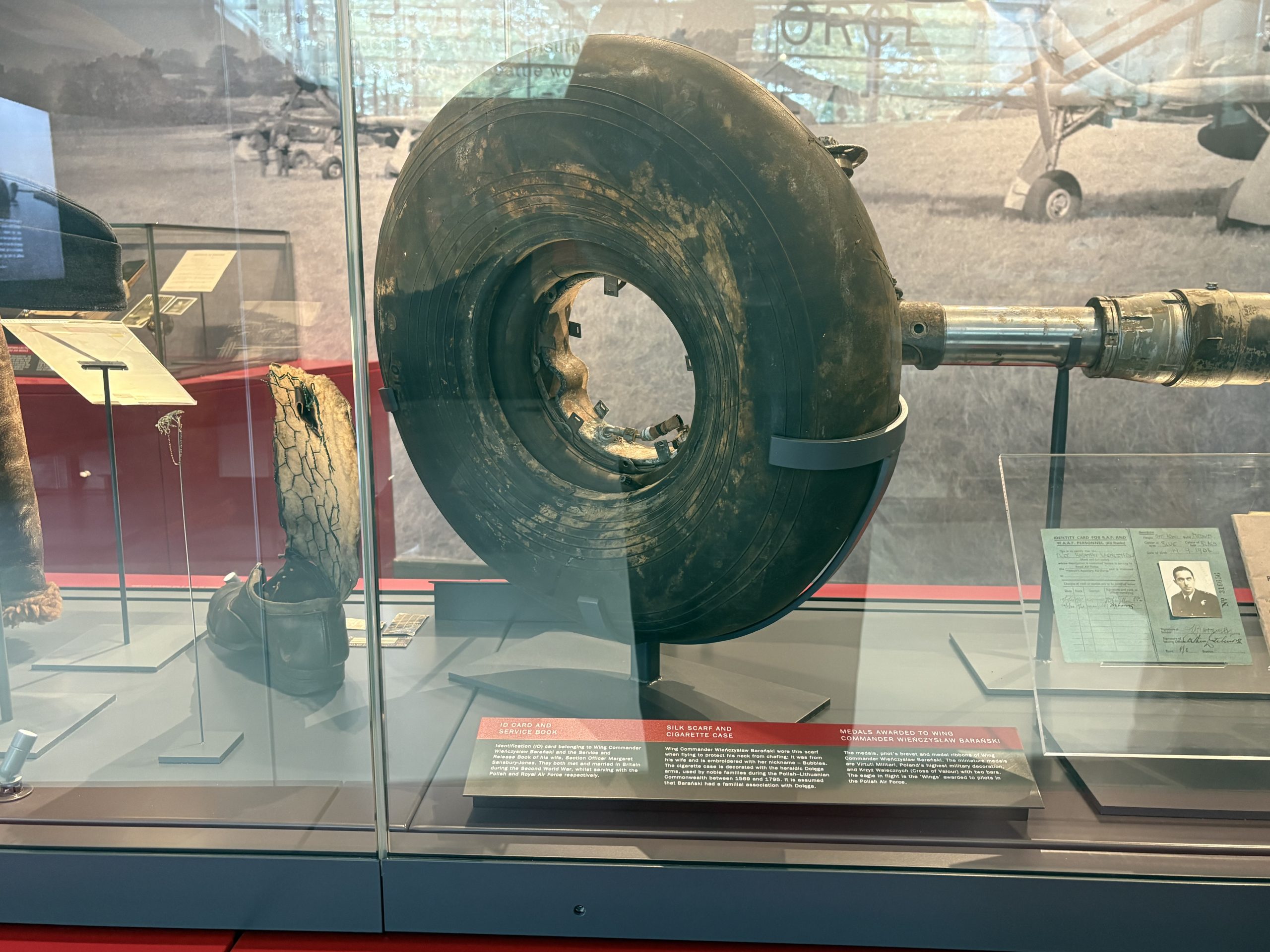
Spitfire Tyre and Main Wheel Leg
Spitfire Tyre and Main Wheel Leg: Landing equipment from Spitfire R7161 flown by Flight Lieutenant Olgierd Ilińksi who served with No. 308 Squadron. On 16 August 1943, Ilińksi was acting as close escort to bomber aircraft over northern France. After the mission was complete and the Squadron were returning to base, they were attacked by the Luftwaffe and Ilińksi was shot down and killed.
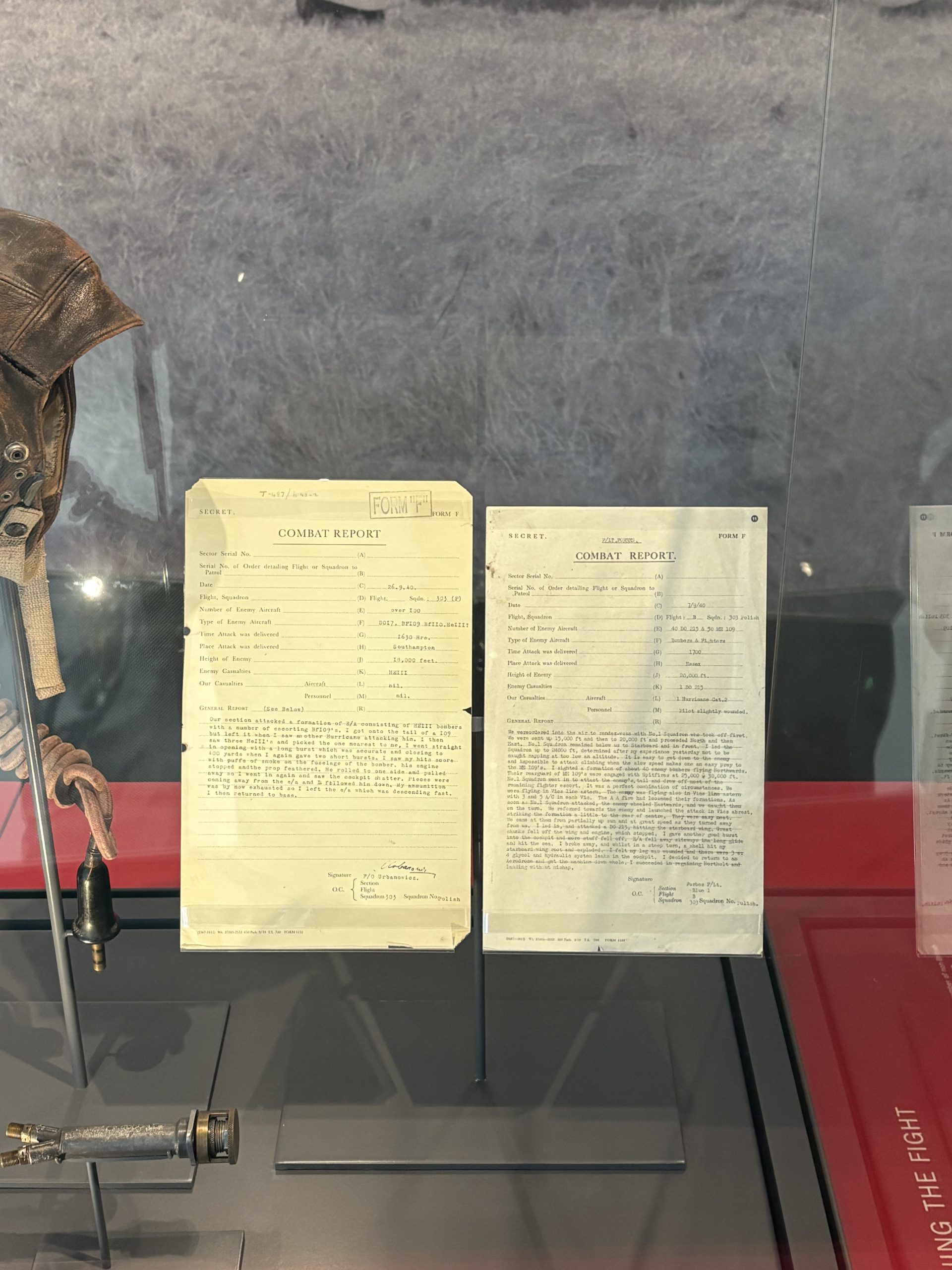
Battle of Britain Combat Reports
Battle of Britain Combat Reports, on loan from Constructive Heritage LLP. Operational documents recorded a pilot’s combat experience for a particular day. Information included location of attack, types of enemy aircraft and number of casualties. These reports were by Flying Officer Witold Urbanowicz (replica) and Flight Lieutenant Athol Forbes (original) who served with No. 303 Squadron.
Polish Air Force Standard
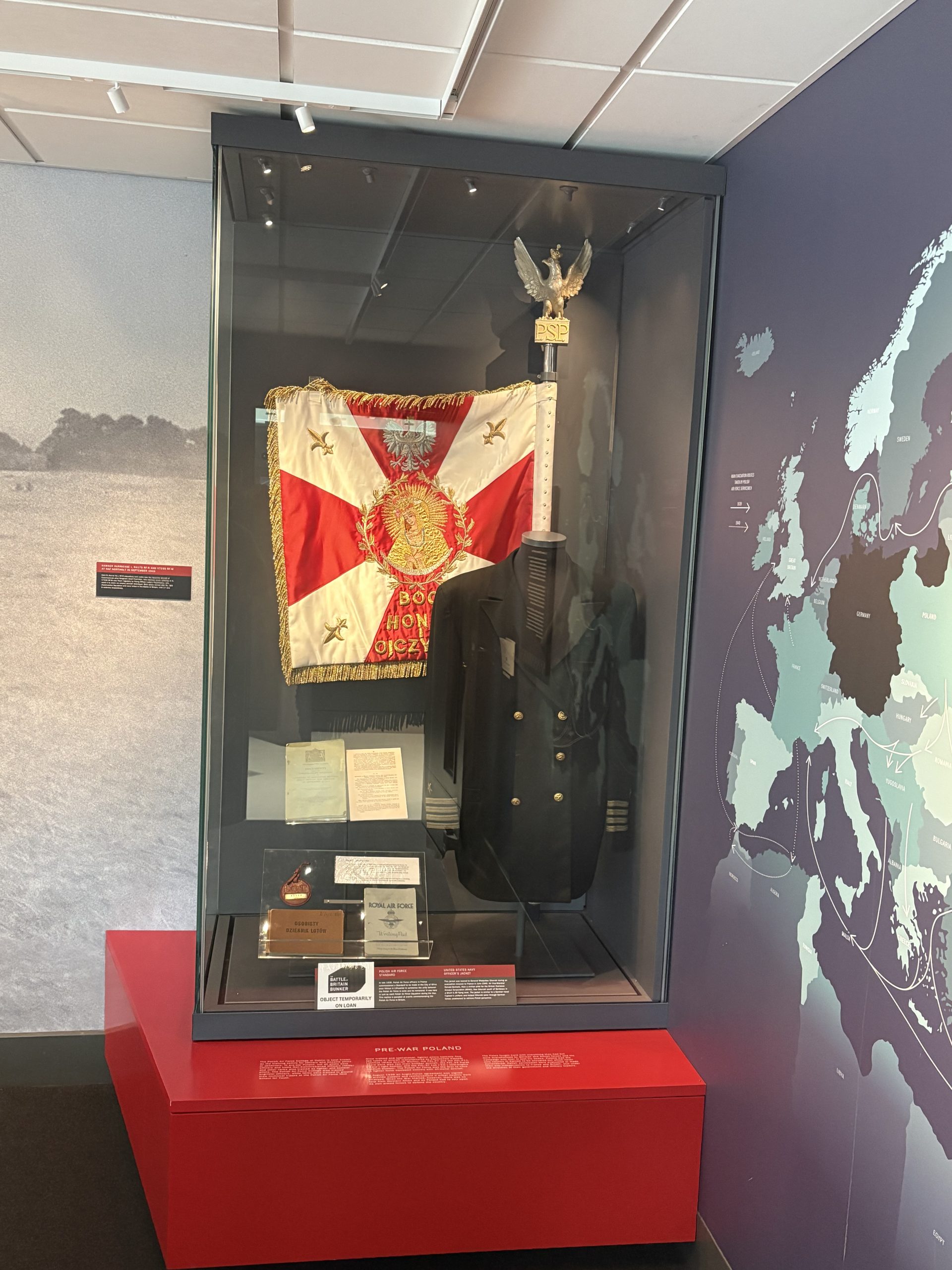
The Standard was initially held by 300 Squadron and then successively passed in turn to the majority of the Polish squadrons that served alongside the RAF until the end of the war.
The original Standard was held by the Polish Institute, until it could be returned to Poland. This happened after the fall of the Communist regime, and after being restored, it was put on display in the Polish Air Force Museum in Deblin.
Several replicas were made, including one for the PAFMC. It is paraded at the annual commemoration of fallen Polish airmen at the PAF Memorial at South Ruislip, and at other commemorative events.
Probably one of the most significant items in the exhibition. It is a replica of a Standard for Lotnictwo (Aviation).
Rear side designed by Cadet Officer Kazimierz Karaszewsk. Central image of Saint Thérèse of Lisieux supported on a sword and a cross. Above and central to this is the inscription WILNO 1940 and below it MIŁOŚĆ ŻĄDA OFIARY (Love Demands Sacrifice). In the upper left corner there is a Polish pilot’s wings, or Gapa, and in the upper right a white and red chequerboard, the national marking of Polish military aircraft. At the lower left is a badge of the cadet officer school of Aviation and on the right a Polish air observer’s or navigator’s Gapa.